Cocktail Ratios & Proportions: The Math Behind Great Drinks
The best bartenders don’t memorize recipes. They understand ratios.
Once you grasp how spirits, modifiers, and citrus balance in a cocktail, you can create endless variations, understand why classic recipes work, and troubleshoot drinks that don’t taste right. You can walk into any bar and understand what’s in a drink just by tasting it. You can modify recipes to match your preferences without destroying the cocktail’s structure.
This guide breaks down the fundamental ratios behind every category of cocktail, explains why they work, and shows you how to apply them at home. Whether you’re mixing your first cocktail or your thousandth, understanding ratios turns you from someone who follows instructions into someone who understands bartending.
Why You’ll Love It
- Learn the mathematical foundation of classic cocktails
- Understand why certain drinks taste balanced and others don’t
- Create your own cocktail variations with confidence
- Modify recipes to match your taste preferences
- Impress people with your knowledge of cocktail structure
- Never forget another recipe again
The Foundation: Understanding Cocktail Categories by Ratio
All cocktails fit into a few core categories defined by their proportions of spirit, modifier, and citrus. Once you know these ratios, you understand the entire cocktail world.
The Three Components of Most Cocktails:
- Spirit: The base alcohol (vodka, gin, rum, tequila, whiskey, etc.)
- Modifier: Secondary ingredients that add flavor, sweetness, or balance (vermouth, liqueurs, juices, etc.)
- Citrus: Fresh juice (lemon or lime) that brightens and balances
Every category of cocktail uses these components in different proportions. Master these proportions, and you master bartending.
Ratio #1: The Sour (2:1:0.75 or 2:1:1)
The Sour is the most important ratio in bartending. If you learn only one ratio, learn this one. It’s the foundation for more cocktails than any other.
Formula: 2 parts spirit : 1 part citrus : 0.75 parts sweetener
Or simplified: 2 parts spirit : 1 part citrus juice : 1 part simple syrup (if using equal parts citrus and syrup)
Standard Measurements (for a single drink):
- 2 oz spirit (whiskey, rum, vodka, tequila, brandy, etc.)
- 0.75 oz fresh citrus juice (lemon or lime)
- 0.5 oz simple syrup (or 0.75 oz if your juice is very sour)
Why This Works: The 2:1 base provides enough spirit to taste, the citrus cuts through and brightens, and the sweetener balances the acid. This ratio has survived 200+ years of bartending for a reason: it’s mathematically perfect.
Drinks Built on the Sour Ratio:
- Daiquiri (rum sour)
- Gimlet (gin sour with sweetened lime cordial instead of simple syrup)
- New York Sour (whiskey sour variant)
- Margarita (tequila sour with triple sec as the sweetener)
- Brandy Alexander variant (adjust ratios for cream-based sours)
Pro Tip: Fresh citrus juice is critical. Bottled juice changes the ratio significantly. If using bottled juice, reduce citrus slightly and increase syrup to compensate, but honestly, fresh juice tastes dramatically better.
Ratio #2: The Spirit-Forward Drink (3:1 or Higher)
Spirit-forward drinks are all about the base spirit. They use minimal modifier, just enough to balance without overwhelming.
Formula: 3+ parts spirit : 1 part modifier (or less)
Standard Measurements:
- 2 to 2.5 oz spirit
- 0.5 to 0.75 oz modifier (vermouth, fortified wine, or aromatic ingredient)
- Bitters (usually 2-3 dashes)
Why This Works: When you want to taste the spirit clearly, you minimize other flavors. The small amount of modifier adds complexity without hiding the spirit’s character. Bitters bridge the flavors together.
Drinks Built on Spirit-Forward Ratios:
- Old Fashioned (spirit + sugar + bitters + water)
- Manhattan (spirit + vermouth + bitters, roughly 2:1)
- Martini (gin or vodka + dry vermouth, typically 6:1 or even higher)
- Sazerac (rye whiskey + absinthe rinse + bitters)
Pro Tip: Spirit-forward drinks are where you taste quality. A premium spirit shows in these drinks far better than in fruit-heavy cocktails. This is where your investment in good whiskey or gin pays off.
Ratio #3: The Equal-Parts (1:1:1)
Equal-parts cocktails are balanced by design. Each component contributes equally, creating harmony without any single flavor dominating.
Formula: 1 part spirit : 1 part modifier : 1 part modifier (or citrus)
Standard Measurements:
- 0.75 oz spirit
- 0.75 oz first modifier (liqueur, vermouth, or amaro)
- 0.75 oz second modifier (different liqueur, vermouth, or amaro)
Why This Works: With three equal ingredients, no single flavor overpowers. Every component is equally important, creating complex drinks with multiple flavor layers. These are sophisticated, sippable cocktails.
Drinks Built on Equal-Parts Ratios:
- Negroni (gin + Campari + sweet vermouth, the most famous equal-parts cocktail)
- Negroni Sbagliato (Negroni with Prosecco for low-ABV version)
- Americano (Campari + sweet vermouth + soda water)
- Last Word (gin + chartreuse + green creme de menthe + lime juice)
Pro Tip: Equal-parts drinks are the most forgiving. Since everything’s balanced, slight variations in pour don’t ruin the cocktail. They’re also perfect for sipping slowly and appreciating complexity.
Ratio #4: The Daiquiri-Style Sour (2:0.75:0.5)
This is the classic Daiquiri ratio, slightly different from the standard sour because it uses less citrus and less sweetener. It’s sharper, more spirit-forward than a typical sour.
Formula: 2 parts spirit : 0.75 parts citrus : 0.5 parts sweetener
Standard Measurements:
- 2 oz rum (traditionally aged rum)
- 0.75 oz fresh lime juice
- 0.5 oz simple syrup
Why This Works: The reduced citrus and sugar mean you taste the spirit more clearly. This creates a drier, more balanced drink than the standard sour. It’s elegant and sophisticated.
Drinks Built on This Ratio:
- Daiquiri (the classic)
- Banana Daiquiri (add 0.5 oz banana liqueur, reduce simple syrup)
- Mango Daiquiri (substitute or add mango juice)
Pro Tip: This ratio works beautifully with aged spirits. The dryness lets wood tannins and barrel notes shine. Try this with aged rum, brandy, or aged whiskey.
Ratio #5: The Low-ABV Aperitivo (1:1 spirit to modifier or lower)
Low-ABV cocktails flip the traditional ratio. Instead of spirit-dominant, they’re modifier-dominant or balanced, creating drinkable, refreshing cocktails you can nurse for hours.
Formula: 1 part spirit (lower proof) : 1 part modifier : 1 part mixer (often soda or wine)
Standard Measurements:
- 1 oz lower-proof spirit (vermouth, aperitivo like Aperol, fortified wine)
- 1 oz additional modifier (another vermouth, amaro, or liqueur)
- 1-2 oz mixer (soda water, Prosecco, tonic, ginger beer)
Why This Works: By reducing spirit and increasing mixer, you create drinks that are 8-12% ABV instead of 20-25%. They’re refreshing, less intense, and perfect for longer social drinking sessions.
Drinks Built on Low-ABV Ratios:
- Aperol Spritz (Aperol + Prosecco + soda)
- Campari Spritz (Campari + Prosecco + soda)
- Americano (Campari + vermouth + soda, lower ABV than Negroni)
Pro Tip: Low-ABV ratios are perfect for lunch cocktails or pacing yourself in a long evening. You can enjoy more drinks without overindulging.
How to Modify Ratios for Your Taste
Once you understand ratios, you can adjust cocktails to your preferences. Here’s how:
If a cocktail tastes too sweet: Increase citrus slightly or reduce simple syrup. The acid from citrus balances sweetness.
If a cocktail tastes too sour: Increase sweetener or reduce citrus. Or add a touch more spirit to mask the acid.
If a cocktail tastes too strong: Increase modifiers or add more mixer (soda, juice, etc.). This works better for some drinks than others.
If a cocktail tastes too weak: Reduce mixer or increase spirit. Or use a higher-proof spirit. Most bar cocktails are 15-25% ABV; if your homemade version is weaker, adjust ratios.
If a cocktail tastes unbalanced: Usually it’s missing acid (citrus) or sweetness (syrup/liqueur). Add a small amount (0.25 oz) of whichever is missing.
Pro Tip: Make notes when you adjust ratios. Keep track of what worked and what didn’t. After a few experiments, you’ll intuitively understand how to balance drinks.
Common Ratio Mistakes Home Bartenders Make
Mistake #1: Using Too Much Simple Syrup Most home bartenders over-sweeten. Start with 0.5 oz and adjust up, never down. You can always add sweetness, but you can’t remove it.
Mistake #2: Using Bottled Lemon or Lime Juice Bottled juice changes the ratio significantly because acidity is different. Always use fresh juice. It’s the cheapest ingredient that makes the biggest difference.
Mistake #3: Pouring by Eye Instead of Measuring Ratios only work if you’re precise. Use a jigger. A 2 oz jigger costs $3 and will improve your cocktails more than any other single tool.
Mistake #4: Ignoring the Spirit Quality In spirit-forward drinks (Old Fashioned, Martini, Manhattan), the spirit is 70-80% of the flavor. Cheap spirits in these drinks taste cheap. Premium spirits shine.
Mistake #5: Not Tasting as You Go Ratios are guidelines, not law. Your palate matters. Taste as you build, adjust if needed, and remember what you did so you can repeat it.
Building Your Own Cocktail Using Ratios
Ready to create your own cocktail? Here’s the framework:
Step 1: Choose Your Ratio Category
- Want something bright and refreshing? Use Sour ratio (2:1:0.75)
- Want to taste the spirit? Use Spirit-Forward ratio (3:1)
- Want balanced complexity? Use Equal-Parts ratio (1:1:1)
- Want something low-ABV? Use Aperitivo ratio (1:1:1+ mixer)
Step 2: Choose Your Spirit This is your foundation. Pick a spirit you like: rum, gin, whiskey, tequila, brandy, vodka.
Step 3: Choose Your Modifier Pick a complementary flavor: citrus juice, vermouth, liqueur, amaro, fortified wine.
Step 4: Apply the Ratio Mix according to your chosen ratio.
Step 5: Add Balance Elements Bitters for spirit-forward drinks, citrus for sours, mixer for low-ABV.
Step 6: Taste and Adjust Does it work? If not, adjust one element at a time.
Example: You have aged rum and want something spirit-forward. You apply the 3:1 ratio: 2.5 oz rum + 0.75 oz sweet vermouth + 2 dashes Angostura bitters. You taste it. Perfect. You just created a rum-based Manhattan variant.
Bartender’s Tips for Mastering Ratios
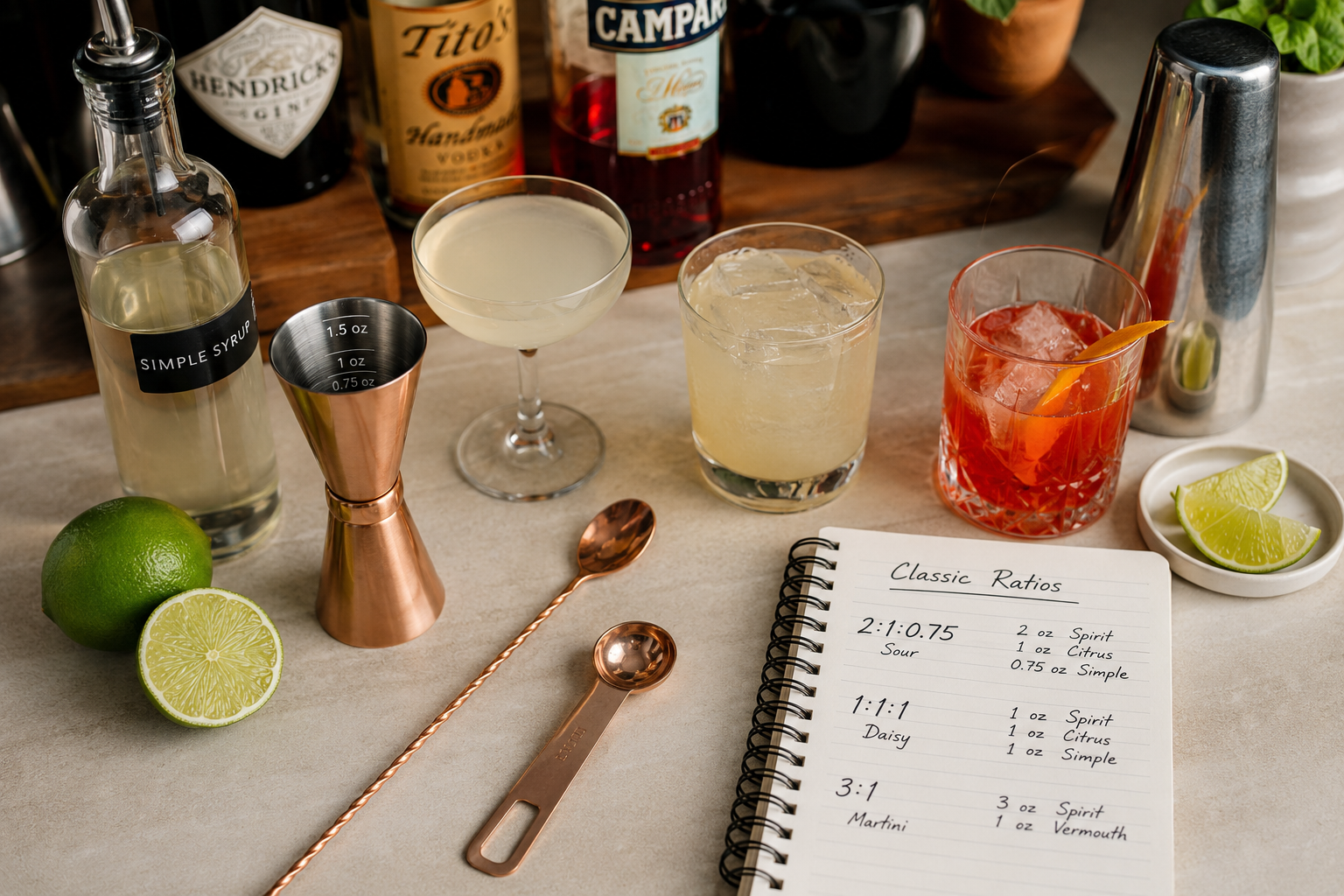
1. Write Down Your Ratios Don’t rely on memory. Create a simple chart: Sour (2:1:0.75), Spirit-Forward (3:1), Equal-Parts (1:1:1). Post it above your home bar. Reference it while you’re learning.
2. Practice with the Same Spirit First Pick one spirit (say, vodka) and make three different cocktails using three different ratios. This lets you taste how ratios change flavor, not how different spirits change flavor.
3. Invest in a Good Jigger A dual-sided jigger (0.5 oz / 1 oz, or 1 oz / 1.5 oz) costs $5-15 and is the single most important measurement tool. Precision matters in cocktails.
4. Keep Fresh Citrus Stocked Fresh lemon and lime juice are non-negotiable. Most citrus ratios assume fresh juice. Bottled juice has different acidity, which throws off proportions.
5. Learn the Classics First, Then Experiment Master Daiquiri, Margarita, Negroni, Old Fashioned, and Manhattan. These teach you every ratio category. Only after you understand the classics should you experiment with modern variations.
6. Taste More Cocktails The more cocktails you taste (at bars or from recipes), the more you understand ratios intuitively. Your palate learns the patterns. Visit bars, try new drinks, pay attention to how different ratios taste.
The Bigger Picture: Ratios Are Guidelines, Not Rules
Here’s the most important thing to understand: ratios are guidelines developed by professional bartenders who have tested thousands of combinations. They work because they’re mathematically sound.
But your palate is unique. Your taste buds might prefer a slightly sweeter or drier cocktail than the standard ratio. Your simple syrup might be thicker or thinner than average, changing how it mixes. Your fresh lime juice might be more or less acidic depending on the time of year.
Use ratios as your starting point. Then taste, adjust, and find your personal sweet spot. Once you do, write it down so you can repeat it.
Next Steps: Apply What You’ve Learned
The best way to master cocktail ratios is to practice. Pick one ratio. Learn three cocktails that use it. Make those drinks multiple times. Then move to the next ratio.
Browse our complete cocktail recipe database and look for drinks organized by spirit type or complexity. Notice how many follow these core ratios. You’ll start seeing the patterns everywhere.
Make note of which ratios match your taste preferences. Love Daiquiris? Master the 2:0.75:0.5 ratio and create variations. Love Negronis? Master the 1:1:1 ratio and explore different amaro and vermouth combinations.
The moment you understand ratios, bartending stops being “follow the recipe” and starts being “understand the science.” Your cocktails will improve, you’ll remember recipes without looking them up, and you’ll have the confidence to experiment.
The Bottom Line
Cocktail ratios are the foundation of great bartending. There are only a handful of core ratios, and once you master them, you can understand and create thousands of cocktails. Spirit, modifier, citrus, and sweetness in specific proportions create balance. Master the proportions, master the cocktails.
Start with the Sour ratio. Learn Daiquiri, Gimlet, and Margarita. Then expand to other ratios. Within weeks, you’ll understand why cocktails work and how to make them better. That knowledge is worth far more than memorizing a hundred recipes.