
Long Island Iced Tea
 Share
Share
 Tweet
Tweet
 Pin
Pin
Rate This Recipe
(4.7 - 3 votes)Thanks for your rating!
Comments:0
(be the first to comment)

 4.1
4.1
Thank you for your comment.
Once it's approved, it will appear here.
What is Long Island Iced Tea?
The Long Island Iced Tea is one of the most debated origin stories in cocktail history, with two competing accounts that have never been fully resolved. The most widely accepted version credits Robert "Rosebud" Butt, a bartender at the Oak Beach Inn on Long Island, New York, who reportedly created the drink in 1972 as part of a competition to make a new cocktail using triple sec. The competing account attributes a version of the recipe to a place called Long Island in Kingsport, Tennessee, during Prohibition, when a local named Old Man Bishop allegedly made a similar concoction from moonshine and other available spirits. Whatever its precise origin, the modern standardised recipe emerged through the 1970s and 1980s and became one of the defining drinks of American bar culture through the 1990s, appearing on virtually every bar menu in the country and generating an entire family of variations including the Adios Motherfucker, the Texas Iced Tea, and the Long Beach Iced Tea. Its lasting appeal is rooted in a genuine paradox: five spirits combined with citrus and cola produce a drink that tastes considerably lighter and more refreshing than its alcohol content warrants, making it simultaneously one of the strongest and most approachable cocktails in the standard repertoire.
If you love classic crowd-pleasers that deliver serious kick without sacrificing taste, this cocktail belongs in your rotation. It pairs perfectly with party nights, summer gatherings, and any moment that calls for something unapologetically strong. If you’re exploring iconic mixed drinks, you might also enjoy the refreshing balance of the French 75, another timeless favorite with its own bold personality.
Don't forget to see what other drinks you can make with the ingredients you already have in your bar.
Taste profile
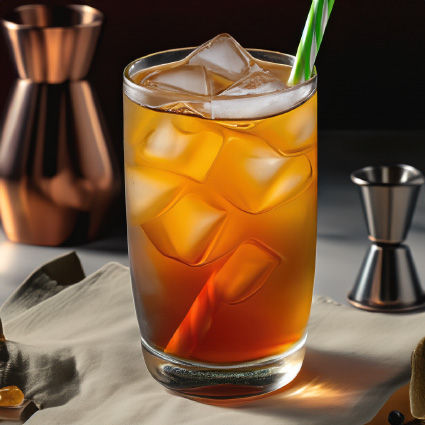
The Long Island Iced Tea is citrus-forward, lightly sweet, and deceptively smooth for a drink containing five base spirits. Fresh lemon juice and simple syrup provide the sour-sweet backbone that holds the drink together, while the cola float adds a caramel sweetness and a faint bitterness on the finish that genuinely mimics the character of iced tea without containing a drop of it. The five spirits contribute to the overall alcoholic warmth without any single one asserting itself over the others: vodka and white rum provide clean neutral body, gin adds a subtle botanical note, blanco tequila contributes a faint agave earthiness, and Cointreau brings a sharp orange bitterness that ties the citrus elements together. The result is a drink that tastes refreshing and citrusy on the palate while delivering a considerably more significant alcoholic impact than the flavour profile suggests, which is both the cocktail's greatest achievement and its most reliable warning.
Serving suggestions
Build directly in a tall Collins glass over plenty of ice rather than shaking: this is a built cocktail in the traditional sense, and the gentle stir that follows the cola addition is all the mixing it needs. Add all spirits and the lemon juice and simple syrup over the ice first, give a single brief stir to combine, then top with just enough cola to create the characteristic amber colour. The cola is not a dominant flavour here: it is a colouring agent and a finishing touch, and too much will dilute the drink significantly and flatten the citrus profile. A lemon wedge squeezed and dropped into the glass is the standard garnish and adds a final citrus brightness. Use equal parts of all five spirits precisely: the Long Island Iced Tea is one of the few cocktails where the balance between spirits is genuinely critical, and skewing any single ingredient throws the whole drink noticeably off. For a stronger result, use fresh lemon juice rather than sweet and sour mix, which produces a cleaner, more focused citrus character that lets the individual spirits come through more clearly.
Why You'll Love It?
- Five spirits combined with citrus and cola produce a drink that genuinely tastes lighter than it is: the flavour paradox that has kept this on every bar menu in America for fifty years.
- The cola is not a mixer here, it is a colouring and finishing agent: too much drowns the citrus profile entirely, so a splash is the correct measure rather than a full pour.
- Equal parts of all five spirits is not a suggestion, it is the structural rule: skew any single ingredient and the balance that makes this drink work collapses immediately.
- Fresh lemon juice rather than bottled sour mix is the single upgrade that separates a good Long Island Iced Tea from a great one: cleaner citrus, more defined spirit character, noticeably better finish.
- This is the original template for an entire family of multi-spirit cocktails including the AMF, the Texas Iced Tea, and the Long Beach Iced Tea: understanding the base recipe makes every variation immediately intuitive.
Ingredients for Long Island Iced Tea
| My Bar | |
|---|---|
| ¾ oz vodka (buy) | ✘ |
| ¾ oz cointreau liqueur (buy) | ✘ |
| ¾ oz lemon juice (freshly squeezed) (buy) | ✘ |
| ¾ oz simple syrup (buy) | ✘ |
| ¾ oz gin (buy) | ✘ |
| ¾ oz blanco tequila (buy) | ✘ |
| ¾ oz white rum (buy) | ✘ |
| 2 oz coca-cola (buy) | ✘ |
| change measure > | |
As an Amazon Associate I earn from qualifying purchases.
Step‑by‑Step Instructions
- Combine the vodka, gin, white rum, blanco tequila, Cointreau (or triple sec), fresh lemon juice, and simple syrup in a Collins glass without ice.
- Stir briefly with a bar spoon to combine all the spirits and mixers.
- Fill the glass with ice.
- Top with 1-2 oz of cola and stir once more, gently, so you don't lose the carbonation.
- Garnish with a lemon wedge on the rim and serve with a straw.